AI brand visibility
AI brand visibility is the share of AI answers that name your company when a buyer asks about your category. It has three layers: engines have to reach your pages, understand what you sell, and then pick you from memory. The third layer leans mostly on what other sites say about you.
By The Promptscope team (Product and testing). Last updated .
How to get a first read on your brand, step by step
- Type your domain into the box above, for example shopify.com, and start the free readiness audit.
- Wait a second while the audit fetches your home page, robots.txt, llms.txt and sitemap.
- Then fix the first two layers, because crawler access and clear markup are fully yours to control.
- Finally, run the mention check, since sampling real answers is the only way to see the third layer.
The first 3 runs each day are free. After that, see the pricing page for packs and plans, or read how we test the tool.
AI brand visibility run against a real site
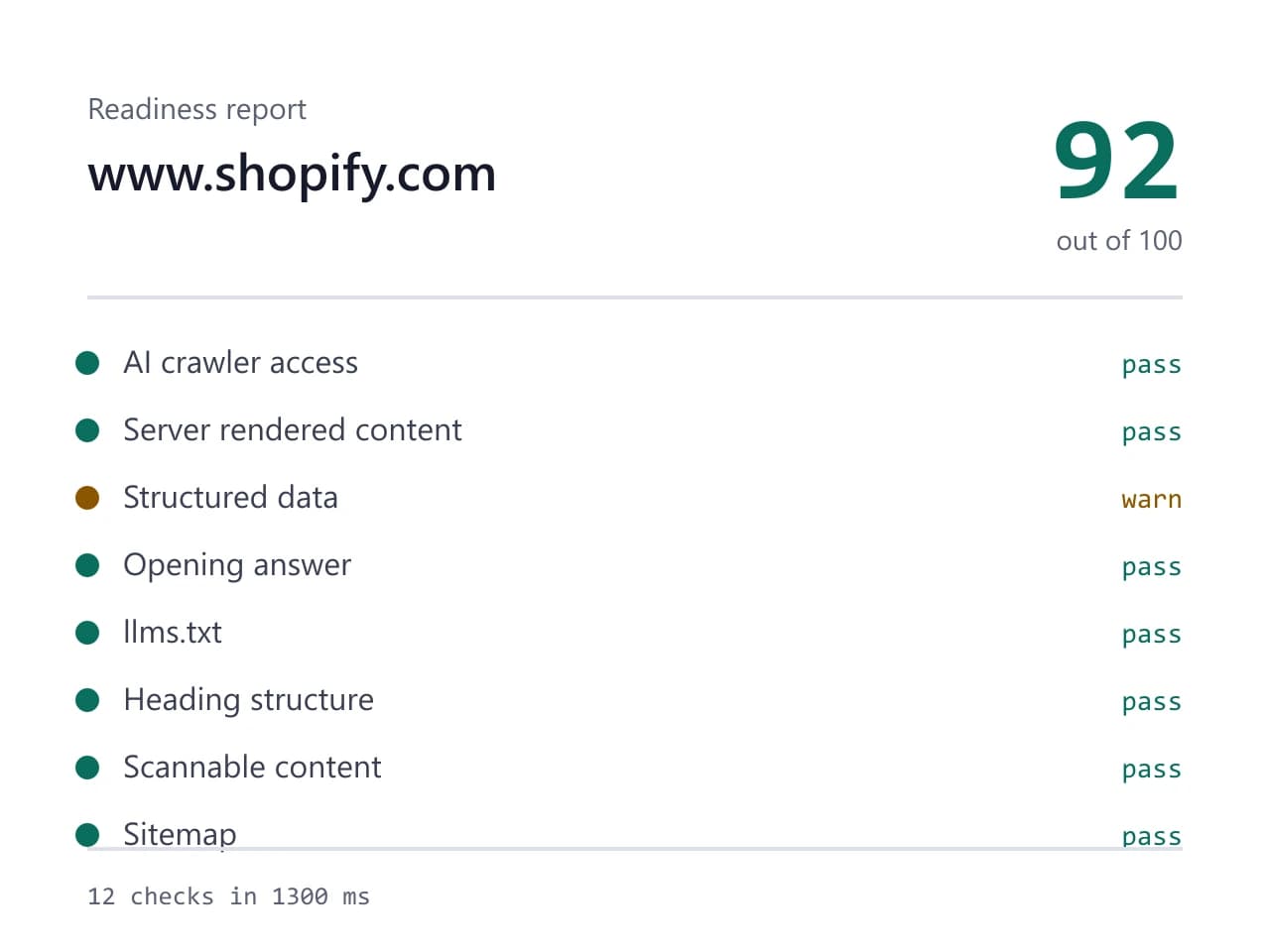
We pointed this checker at shopify.com and kept what came back. So the card below is an actual report rather than a mockup, and you can run the same check yourself and compare.
- Site we checked
- shopify.com
- Readiness score
- 92 / 100
- Checks run
- 12
- Needs a fix
- 0
- Warnings
- 2
- AI crawlers allowed
- 8 of 8
- Checked on
- 2026-10-16
How we test: every page runs the same checks against a different real site, and we read each report by hand before publishing it. More on the about page.
The three layers of AI brand visibility
Think of it as three layers stacked in order. First, an engine has to reach your pages, which is a crawling question and nothing more. Second, it has to work out who you are and what you sell, which is a clarity question. Third, it has to name you when somebody asks about your category, and that is a reputation question. Each layer rests on the one below it, so a failure at the bottom makes the top impossible.
Most teams work only on the bottom two, because those live on their own website. So they clean up robots.txt, add Organization markup, and write a plain opening sentence. That work is real and it is cheap. However, it buys eligibility rather than mentions. A marketing lead can carry that single distinction into a meeting and save everyone a quarter of confusion.
Why other sites decide whether you get named
The third layer is the awkward one, since you do not own it. A model builds its sense of your brand from the whole web, which means roundups, forum threads, documentation, news coverage and rival comparisons. Your own pages are one voice in that pile. Therefore a company nobody else writes about stays quiet in answers, no matter how tidy its markup is.
This is also why owned site fixes hit a ceiling. Once an engine can read you and place you in a category, more schema stops moving the needle. Instead, the next gain comes from showing up where other people describe your category. For example, that means getting into the comparison posts that already rank, answering questions in public, and publishing numbers somebody wants to cite. The work is slower, although it is the part that changes whether a model reaches for your name.
A shortlist of three names, not a page of ten links
Search used to return ten links and let the buyer browse. An answer engine returns a paragraph with two or three names in it. That is a much smaller stage. Being fourth on a results page still earned clicks, because the page listed everybody anyway. Being fourth in a model's answer usually earns nothing, since the answer stopped at three.
So the goal shifts from ranking to being one of the few. In addition, the buyer often never opens a website before forming a shortlist. They read the answer, keep a name or two, then search for those names directly. As a result, your first impression can happen inside a sentence you did not write. AI brand visibility is really a measure of how often you make that sentence.
What nobody can measure about AI brand visibility
Start with the honest part. Nobody outside a model lab can tell you what sits in the training data, or whether your pages were included. There is no lookup for that. Claims about a brand's share of a training set are guesses dressed up as metrics, so treat any tool that sells one with suspicion.
Ranking internals are just as closed. No external tool knows why a model chose three names over five others, what weight it gave a citation, or how a version update shifted the mix. What you can watch is the output: ask the same buyer questions on a schedule and record which brands come back. That is sampling rather than measurement, although a dated series still shows direction. Finally, answers vary between runs, so one result on its own proves very little.
The layers and signals, and how much of each you control
| Layer or signal | How much control you have |
|---|---|
| Crawler access | fully yours, because one robots.txt line decides it |
| Structured data | fully yours, since Organization markup names the entity |
| Opening answer sentence | fully yours, and engines quote it often |
| One consistent brand name | fully yours, although it takes a cleanup pass |
| Third party roundups | influence only, because somebody else writes them |
| Community and forum threads | influence only, and buying them usually backfires |
| Training data contents | no view at all from outside a model lab |
| Ranking internals | closed, so only the output can be sampled |
AI brand visibility FAQ
What is AI brand visibility in plain terms?
It is how often answer engines name your company when a buyer asks about your category. Three things have to go right: an engine has to reach your site, grasp what you sell, and then recall you while it answers. The first two are engineering tasks, while the third depends on what the rest of the web says about you.
Is this just SEO with a new name?
The overlap is real, because both care about pages a machine can fetch and understand. However, the target differs. Classic SEO asks where you sit in a list of links, while this asks whether you get named inside a short answer. Link counts matter less here than a clean entity and steady coverage on other people's sites.
How do I report AI brand visibility to leadership?
Use the three layers as the structure. Layers one and two are engineering work with a deadline, so report them as done or not done. Layer three is a trend, therefore report it as a mention rate across dated runs instead of a single score. Also bring the competitor list, since that usually starts the more useful conversation.
Can I pay to get named by ChatGPT?
No, and nobody can honestly sell you that. There is no ad slot inside a model answer, and no vendor can write your brand into training data. What you can do is remove the technical reasons an engine skips you, then earn coverage on the pages a model already reads.
How often should I check?
Monthly suits most brands. Readiness barely moves unless somebody ships a change, so the useful trigger is any deploy that touches robots.txt, templates or markup. Mention sampling drifts more, because models update between versions, and a dated monthly run gives you direction without burning credits.