AI visibility checker
This AI visibility checker reads your site the way an answer engine does and scores it from 0 to 100. It reports whether your robots.txt blocks AI crawlers, whether your markup parses, and whether your pages answer a question in the opening lines. Every result shows the evidence behind it.
By The Promptscope team (Product and testing). Last updated .
How to check your AI visibility, step by step
- Type your domain into the box above, for example example.com, and press the button.
- Wait about a second while the checker fetches your home page, robots.txt, llms.txt and sitemap.
- Then read the score and work down the list, because the rows are ordered by how much they matter.
- Finally, fix the red rows first and run the check again to confirm the change landed.
The first 3 runs each day are free. After that, see the pricing page for packs and plans, or read how we test the tool.
AI visibility checker run against a real site
We pointed this checker at stripe.com and kept what came back. So the card below is an actual report rather than a mockup, and you can run the same check yourself and compare.
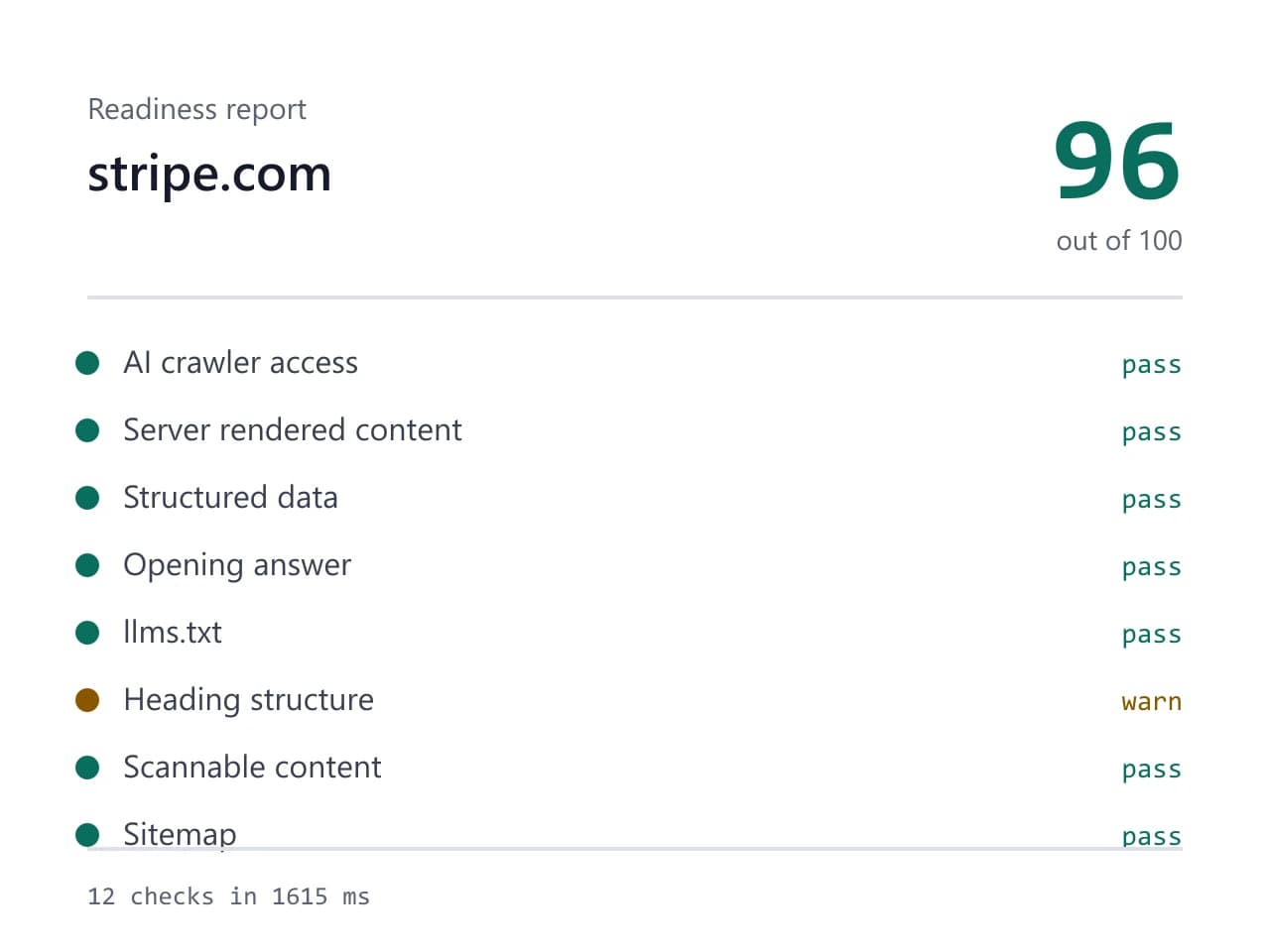
- Site we checked
- stripe.com
- Readiness score
- 96 / 100
- Checks run
- 12
- Needs a fix
- 0
- Warnings
- 1
- AI crawlers allowed
- 8 of 8
- Checked on
- 2026-10-16
How we test: every page runs the same checks against a different real site, and we read each report by hand before publishing it. More on the about page.
What the AI visibility checker actually measures
The checker runs twelve tests and groups them into three questions. First, can an engine reach the page at all? Second, can it understand what the page is about? Third, can it find a sentence worth quoting? Each test returns a pass, a warning or a fix, and each one prints the evidence it saw.
That evidence matters more than the number. For example, a row does not simply say your markup is weak. Instead, it tells you that two of three JSON-LD blocks failed to parse, so you know which file to open. A score without proof is guesswork, and this market already has plenty of that.
Why blocked crawlers outrank every other fix
Many sites quietly block the bots that feed AI answers. A security plugin adds a rule, or a template ships with a boilerplate robots.txt, and suddenly GPTBot cannot fetch a single page. Nothing else on the list can help after that, because the engine never sees your content.
So the checker treats crawler access as a gate rather than a normal row. While any AI crawler stays blocked, your score is capped and the report says exactly which rule caused it. Once you remove the rule, the cap lifts and the rest of the list starts to count again.
Reading the score without fooling yourself
A high score means an engine can read and parse your site. However, it does not promise that ChatGPT will name your brand tomorrow. Those are two different questions, and honest tools keep them apart.
Readiness is the part you fully control, so it comes first. Afterwards, the mention check asks real buyer questions and records which brands come back. Run the readiness check first, because fixing a blocked crawler changes the second answer in a way no amount of content ever will.
When this AI visibility checker is the wrong tool
This page checks one URL at a time. Therefore, a large site with thousands of templates needs a crawler instead, since a single home page cannot represent every section.
It also reads the HTML your server returns. As a result, content that only appears after JavaScript runs will look missing here. That is a useful warning rather than a bug, because several AI crawlers behave the same way.
The twelve checks and what each one weighs
| Check | Why it counts |
|---|---|
| AI crawler access | a blocked bot never reads the page, so this caps the score |
| Server rendered content | most AI crawlers do not run JavaScript, so a browser built page reads as empty |
| Structured data | tells an engine what your brand is and what it sells |
| Opening answer | engines quote the first plain sentence far more than the rest |
| Scannable content | lists and tables get lifted more readily than paragraphs |
| Heading structure | one clear H1 makes the subject of the page unambiguous |
| Sitemap | crawlers find every page instead of the ones they stumble into |
| llms.txt | a cheap hint about which pages you want quoted |
| HTTPS, canonical, title, meta | the basics that decide how the page is stored |
AI visibility checker FAQ
Is this AI visibility checker free?
Yes. The readiness check calls no language model, so a run costs us almost nothing and we do not meter it. You do not need an account either. The mention check, which asks real buyer questions, uses credits because each run has a real cost.
Which AI crawlers does it test for?
Eight: GPTBot, OAI-SearchBot and ChatGPT-User for OpenAI, ClaudeBot and Claude-SearchBot for Anthropic, PerplexityBot, Google-Extended for Gemini grounding, and Applebot-Extended. The report names each one and quotes the robots.txt rule that blocked it.
How is this different from a normal SEO audit?
A traditional audit asks where you rank for a keyword. This asks whether an engine can read your page and find an answer in it. The overlap is real, but the priorities differ: llms.txt, JSON-LD and a direct opening sentence matter far more here than link counts.
Does a good score mean ChatGPT will recommend me?
No, and any tool that promises that is selling something. Readiness means an engine can use your site. Whether it names you also depends on what others say about you and how well known your category is. The mention check measures that part separately.
Do you store the pages you fetch?
No. We read your public pages, parse them into the findings you see, and keep nothing else. The raw HTML never leaves the server and never reaches your browser.