Improve brand visibility in AI answer engines
Improve brand visibility in AI answer engines by working in payoff order, not alphabetical order. First unblock the AI crawlers, because nothing else counts while they cannot reach you. Then put a quotable answer in your first forty words, add structured data, make pages scannable, and finally earn the third party mentions that engines cite.
By The Promptscope team (Product and testing). Last updated .
How to run the readiness check before you start, step by step
- Type a domain into the box above, for example mozilla.org, and press the button.
- Wait about a second while the server fetches the home page, robots.txt, llms.txt and the sitemap.
- Then work the list from the top, because it already sorts itself by how much each fix pays back.
- Finally, clear any crawler block first, run the check again, and only then spend time on wording.
The first 3 runs each day are free. After that, see the pricing page for packs and plans, or read how we test the tool.
Improve brand visibility in AI answer engines run against a real site
We pointed this checker at mozilla.org and kept what came back. So the card below is an actual report rather than a mockup, and you can run the same check yourself and compare.
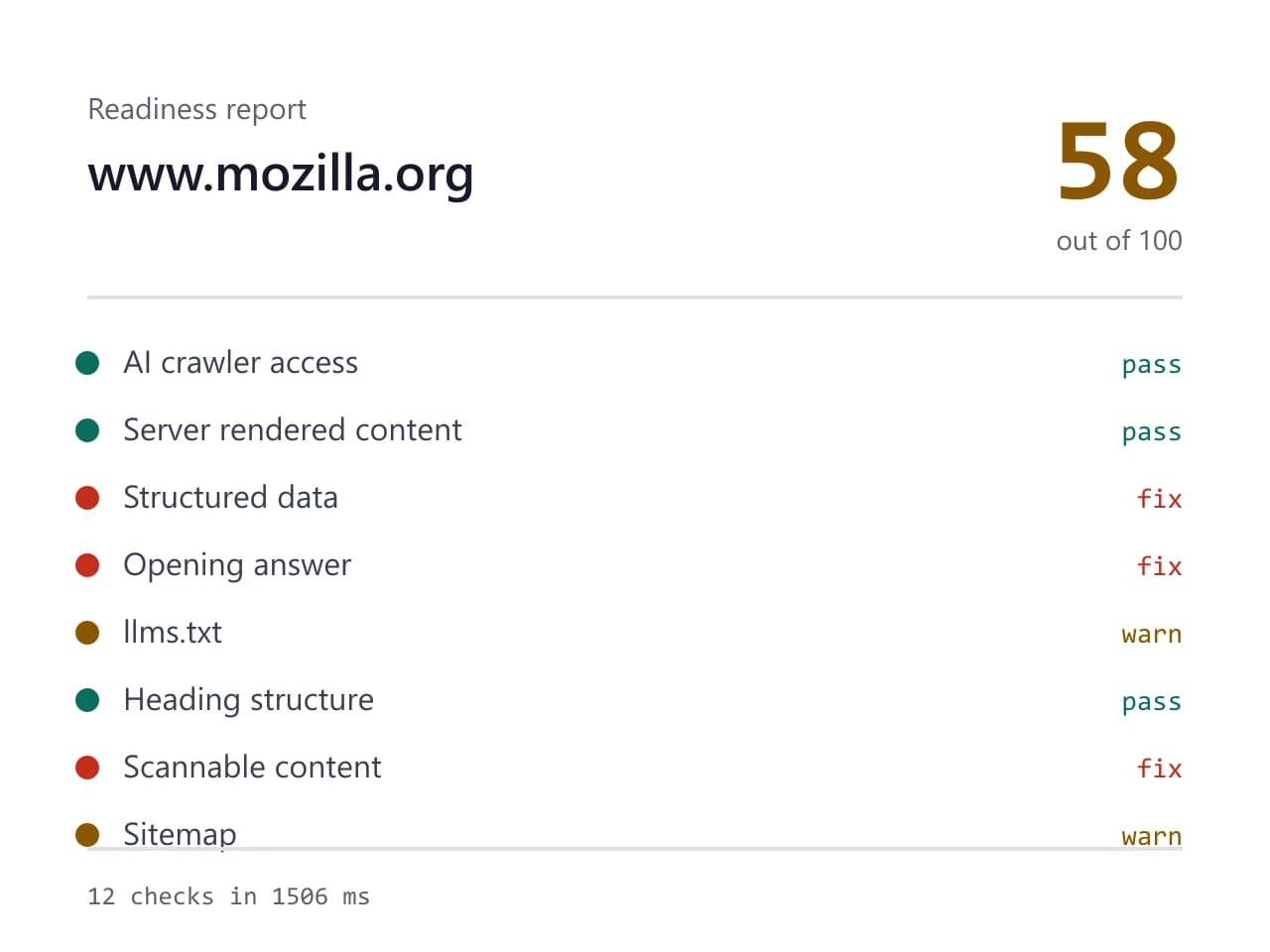
- Site we checked
- mozilla.org
- Readiness score
- 58 / 100
- Checks run
- 12
- Needs a fix
- 3
- Warnings
- 3
- AI crawlers allowed
- 8 of 8
- Checked on
- 2026-10-16
How we test: every page runs the same checks against a different real site, and we read each report by hand before publishing it. More on the about page.
How to improve brand visibility in AI answer engines, in order
Payoff order beats checklist order, so start at the gate. If your robots.txt blocks GPTBot, ClaudeBot or PerplexityBot, then nothing downstream matters, because those engines never fetch a word. The fix takes minutes and needs no writer. Therefore it belongs first, every time. Our readiness check treats crawler access as a gate rather than a row: while any AI crawler stays blocked, the score stays capped and the report quotes the exact rule that caused it.
Next comes the opening of your most important pages. Answer engines quote plain sentences, and they lift them from the top far more often than from the middle. So give each key page a direct answer in the first forty to sixty words, before the story and before the pitch. Then add structured data, since JSON-LD tells an engine which entity it is reading about instead of leaving it to guess. Budget roughly an hour per page for the wording, plus half a day to set up Organization markup once.
Scannable pages, llms.txt, and the mentions you cannot control
After the opening, make the body easy to lift. Lists, short comparison tables and honest subheadings travel better than dense prose, because a model can pull one row without rewriting three paragraphs. Human readers like them too, so this is rarely wasted work. Next, publish llms.txt. It takes about twenty minutes, it points at the pages you want quoted, and support for it is still uneven. Treat it as cheap insurance instead of a lever.
Finally comes the off site half, which matters a lot and moves slowly. Engines cite roundups, review pages, documentation and forum threads, so your brand often gets named on somebody else's domain. You can pitch reviewers, answer questions in public and keep your own product pages accurate. However, you cannot decide who writes about you, and nobody can. Expect months rather than weeks here, and expect less control than anywhere else on this list.
What does not improve brand visibility in AI answer engines
Keyword stuffing does nothing here. A page that repeats one phrase twenty times reads worse to a model than a single clear sentence, so the stuffing costs you the quote you wanted. Mass produced thin pages fail for the same reason. Fifty near duplicate pages hand an engine fifty weak candidates instead of one strong one, and they blur the signal about what your site is actually for.
Also be careful with anyone selling a trick that forces a citation. No prompt, hidden text or markup snippet makes an answer engine name your brand, because the engine weighs many sources and decides at answer time. We will not sell you that, and we do not run it ourselves. The honest version is slower: stay readable, stay quotable, and give people a reason to cite you.
What this tool cannot tell you
The readiness check reads one URL at a time. As a result, a large site with many templates needs a crawler instead, since a single home page cannot represent a docs section or a pricing page. It also reads the HTML your server returns, so content that appears only after JavaScript runs will look missing. That is a fair warning rather than a bug, because several AI crawlers behave the same way.
A good readiness score also proves less than people hope. It shows that an engine can reach, parse and quote your pages. It does not promise that ChatGPT will recommend you tomorrow, since that depends on your category and on what other sites say about you. The mention check measures that half separately: it runs twelve fixed buyer prompts and reports who gets named, where you place, and which domains get cited.
Each move, the work it takes and how fast it shows
| Move | Effort, and how quickly it shows |
|---|---|
| 1. Unblock the AI crawlers | minutes in robots.txt, and engines notice within days |
| 2. Rewrite the first 40 to 60 words | about an hour per page, live on the next crawl |
| 3. Add Organization and FAQPage JSON-LD | half a day once, then it becomes template work |
| 4. Lists and comparison tables | an afternoon per page, and readers benefit too |
| 5. Publish llms.txt | twenty minutes, cheap insurance, no guarantee |
| 6. Earn roundup and review mentions | months of outreach, and you control very little of it |
| Keyword stuffing and thin pages | quick to do, and it moves nothing at all |
Improve brand visibility in AI answer engines FAQ
How long does it take to improve brand visibility in AI answer engines?
It depends on which step you are on. A crawler unblock can show up within days, because engines refetch robots.txt often. Rewritten openings and fresh JSON-LD land on the next crawl of that page. Off site mentions are the slow part, so plan for months there.
What is the fastest fix on the list?
Removing a robots.txt block, by a wide margin. It takes minutes, it needs no writer, and it unlocks everything else on the page. Check it first even when you are sure the site is open, because security plugins and starter templates add these rules quietly.
Do I really need an llms.txt file?
No, it stays optional. Support is uneven and no engine promises to read it, so treat it as cheap insurance rather than a ranking factor. It costs about twenty minutes to write. Our checker reports whether yours exists, has real words and links to real pages.
Can I pay to get mentioned by ChatGPT?
Not in any way we would recommend. There is no citation slot to buy and no markup that forces a mention. What does help is appearing in the roundups and review pages that engines already cite, and you earn that placement instead of buying it.
Should I just publish more blog posts?
Only if each one answers a real question well. Volume alone does not help, because an engine picks one passage to quote and extra thin pages simply add noise. One clear comparison page usually beats ten vague ones.