LLM visibility checker
This LLM visibility checker tests the three pathways a language model uses to reach your content: the training crawl, the retrieval fetch at answer time, and the citation link. It checks eight named agents separately, scores twelve readiness signals from 0 to 100, and prints the evidence behind every row.
By The Promptscope team (Product and testing). Last updated .
How to use the LLM visibility checker, step by step
- Type a domain into the box above, for example wikipedia.org, and start the run.
- Wait about a second while the server fetches the home page, robots.txt, llms.txt and sitemap.xml.
- Then open the crawler access row first, because a blocked agent caps everything below it.
- Finally, fix the failing rows, then run the check again to confirm the new files are live.
The first 3 runs each day are free. After that, see the pricing page for packs and plans, or read how we test the tool.
LLM visibility checker run against a real site
We pointed this checker at wikipedia.org and kept what came back. So the card below is an actual report rather than a mockup, and you can run the same check yourself and compare.
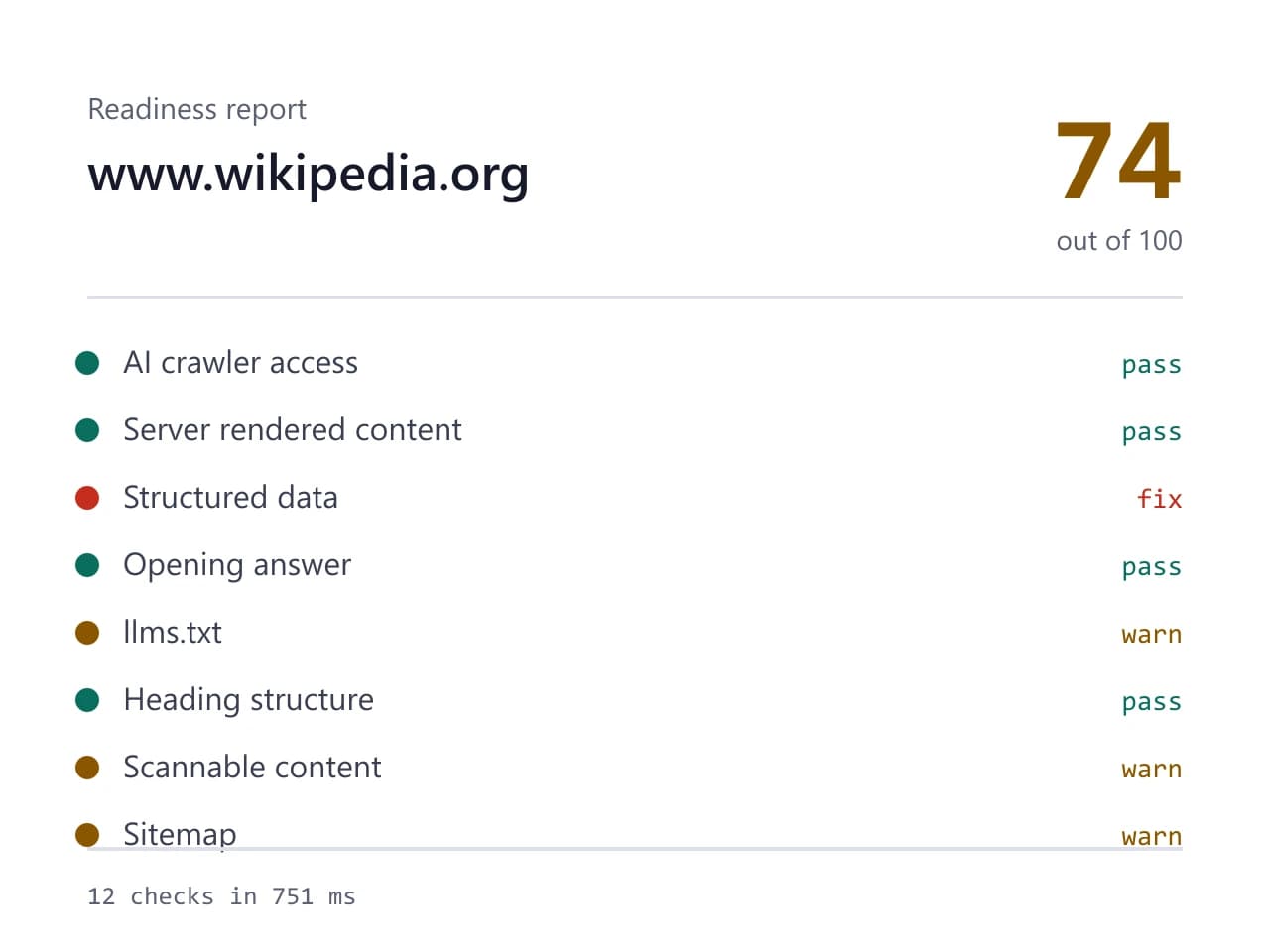
- Site we checked
- wikipedia.org
- Readiness score
- 74 / 100
- Checks run
- 12
- Needs a fix
- 1
- Warnings
- 4
- AI crawlers allowed
- 8 of 8
- Checked on
- 2026-10-16
How we test: every page runs the same checks against a different real site, and we read each report by hand before publishing it. More on the about page.
How your content reaches a language model
A language model does not browse your site while it talks to someone. Instead, your words arrive along three separate paths. The first is the training crawl, which archives pages long before anyone types a question. Retrieval comes next, where a search index or a live fetch pulls a page while the model drafts an answer. Last comes citation, the link an assistant prints next to a claim. Each path runs on its own schedule, so a change you ship today lands on one path within hours and on another one much later.
Those paths also run on different software. For example, a vendor may operate one agent for training and a second agent for search retrieval, each with its own user agent string. Therefore a single line in robots.txt can close one path and leave the other wide open. That outcome is usually an accident rather than a policy. Because the paths stay separate in practice, the checker keeps them separate as well, and it reports each agent by name.
Why this LLM visibility checker names eight separate agents
Most audits collapse AI access into a single yes or no row. However, that shortcut hides the case you actually care about. Your site can welcome a training crawler and still block the agent that fetches a page during a live chat. So the checker parses robots.txt once, then evaluates eight agents against it one at a time: GPTBot, OAI-SearchBot, ChatGPT-User, ClaudeBot, Claude-SearchBot, PerplexityBot, Google-Extended and Applebot-Extended.
Access behaves as a gate here, not as a row, because nothing downstream matters once a fetch fails. While every agent stays blocked, the score stops at 25. When only some are blocked, it stops at 60. In addition, the report quotes the exact rule that caused the block, so you can open robots.txt and find the line without guessing. Once you delete that line, the cap lifts and the remaining checks begin to count.
What the readiness score measures once access is open
After the gate, ten checks look at the page itself. Structured data has to be present and parse cleanly, and it should use a type such as Organization or FAQPage. The opening answer check hunts for a real sentence of fifteen words or more near the top, since models lift plain declarative lines far more readily than marketing copy. Heading structure wants exactly one H1 plus subheadings. Scannable content counts words, lists and tables, because those formats survive summarization.
The rest is plumbing. A sitemap has to sit at /sitemap.xml or appear in robots.txt, the site has to serve HTTPS, and each page needs a canonical URL, a title inside the usual length limit and a meta description inside its own. There is also llms.txt, which the checker reads for words and links. All of this runs without calling a model, so the readiness half stays free and needs no account. The paid mention check is the other half, and it sends twelve fixed buyer prompts to a model to see which brands come back.
What this LLM visibility checker cannot tell you
You cannot observe training data from outside. Nobody can look at a model and confirm that your page sits inside it, so any tool claiming that view is guessing. Ranking works the same way. Vendors keep the logic that picks one source over another private, and therefore a readiness score cannot predict that decision. It proves something narrower and still useful: the mechanics are in place, and no rule of yours stands in the way.
Scope is limited too. The checker reads one URL at a time, so a large site with many templates needs a crawler instead. It also reads the HTML your server returns, which means anything that appears only after JavaScript runs will look missing. Although that can feel unfair, several AI crawlers behave the same way, so treat it as a signal rather than a bug. Finally, a strong score is not a promise that an assistant will recommend you.
The eight agents the checker tests, and the pathway each one serves
| Agent | Pathway it serves |
|---|---|
| GPTBot | the training crawl behind OpenAI models |
| OAI-SearchBot | the index behind ChatGPT search results |
| ChatGPT-User | the live fetch when someone asks about your page |
| ClaudeBot | the training crawl behind Anthropic models |
| Claude-SearchBot | the index behind Claude search answers |
| PerplexityBot | the index behind Perplexity answers |
| Google-Extended | your opt in or opt out for Gemini grounding |
| Applebot-Extended | your opt in or opt out for Apple model training |
LLM visibility checker FAQ
What is an LLM visibility checker?
It is a tool that tests whether a large language model can obtain your content at all. This LLM visibility checker fetches four public files, evaluates eight named crawlers against your robots.txt, and scores twelve readiness signals from 0 to 100. It calls no model during that run, so nothing in the result is generated text.
Why test eight crawlers instead of one?
Because vendors run separate agents for separate jobs, and robots.txt can treat them differently. Blocking a training crawler while allowing a live fetch agent is a real and fairly common configuration. A single combined row would label that site either blocked or open, and both labels would be wrong.
Can you tell if my site is in a model's training data?
No, and neither can anyone else from the outside. Vendors do not publish their training sets, and models do not expose an index you can query. What the checker can show is whether your robots.txt permits the crawlers that collect that data, which is the part you actually control.
Does llms.txt do anything yet?
It is a proposed convention rather than a rule that engines have to honor. Still, publishing it costs almost nothing, and it states plainly which pages you want read. So the checker looks for the file, confirms it holds words and links, and scores it as one signal among twelve.
What happens when I run out of free mention checks?
The server shows the prompt plan, which is the list of twelve buyer questions it would have asked. It calls no model at that point, so you see the real questions instead of a blurred screenshot. Meanwhile the readiness half keeps working, because that half never spends credits.